Showing posts with label garden. Show all posts

Tuesday, 29 March 2011

Is summer over? Sprouting kale - yummy:)

For the last couple of weeks we've had some wonderful, sunny days.  So much so, I've been searching out things to wash and hang out on the line - I know, it's sad, please don't tell anyone!

I've also been sowing seeds like it's going out of fashion.  So far, the only ones to germinate are the kale seeds, but hey, that's a start, and kale is one of my very favourite vegetables.  I suppose that's quite tautological really, I wouldn't be growing it if I didn't like it, would I?  Doh!

However, it's turned cold again now, and I'm very glad I laid some horticultural fleece over my peas, runner and broad bean seeds - their very own little duvets :)

By the way, did you know that if you leave kale in the ground over winter, it then acts like sprouting broccoli?  No, neither did I, but it does! 


The flower heads are absolutely delicious and tender when steamed or boiled briefly, so I have green sprouts along with my purple sprouting broccoli - aren't I lucky?

Sunday, 6 February 2011

In a Maltese garden

To me, as to many of you, I suspect, a poinsettia plant is one that we buy for the Christmas season.  Indeed, they often appear on Christmas cards nowadays, don't they?

I have, in the past, managed to keep one alive for a couple of years, but not much longer than that.  How about you?

You can imagine my delight, then, when I spotted poinsettia trees in even the smallest gardens whilst on holiday in Malta this January :-)

This is one in the front garden of a small block of flats.  This leads me to assume that they are very easy to look after, as I never saw anyone tending their gardens in the three weeks I was there.


I think this is a hibiscus, which has been trained over an arched trellis.  You can see ripe, luscious lemons, ready to drop from the tree behind the blue netting.  Amazingly, we saw so many oranges, lemons and grapefruit rotting on the ground.  Clearly the owners of those trees neither drink gin and tonic, nor make fresh salad dressings or fruit smoothies!!


This was a small, courtyard garden, largely given over to fruit trees.  I was pleased to see that the soil here was not littered with fallen fruit.


Some time ago I asked if any of you could identify some leaves that I had acquired as part of a bouquet of flowers.  I was intrigued by the fact that the flowers appeared both underneath, and on top of, the leaves themselves.  You can imagine my surprise to see these plants growing in swathes.  Not only are the flowers there, to enable me to identify it, but such glorious, ruby berries too!  I still don't know what they are, but, again, they must be easy to grow, and probably worth bearing in mind if we are set to have longer, drier summers - after all, Malta has really hot summers!

Tuesday, 29 June 2010

Lunar Gardening by Gem – ooffoo.com

As you know, I'm not much of a one for growing flowers and pretty things in my garden - I prefer to eat the fruits of my labour. Since fruits and vegetable plants need to flower in order to reproduce, I'm not depriving myself of beauty, my flowers are simply of a less flamboyant nature than all those flower seed packets that fill the shelves in springtime.


So, I found this article on ooffoo interesting, and include the link so that you can take a look for yourself. I'll just give the opening quote to whet your appetite:

"If you with flowers stick the pregnant earth
Mark well the moon propitious to their birth
For earth the silent midnight queen obeys
And waits her course, who clad in silver rays
The eternal round of time and seasons' guides"

From The English Gardener, Seventeenth Century.  Here's the link to the article:

Lunar Gardening by Gem – ooffoo.com

Thursday, 17 June 2010

food for free - butternut squash

As you know, we Yorkshire folk like 'owt for nowt' (something for nothing for those of you who don't speak the dialect!).

I've told you how to get yourself some free potatoes, and this time I'm going to show you how to get yourself some free butternut squashes.  These lovely gourds are fantastic roasted in the oven, or over a barbeque, or made into a delicious soup, or included in a casserole.

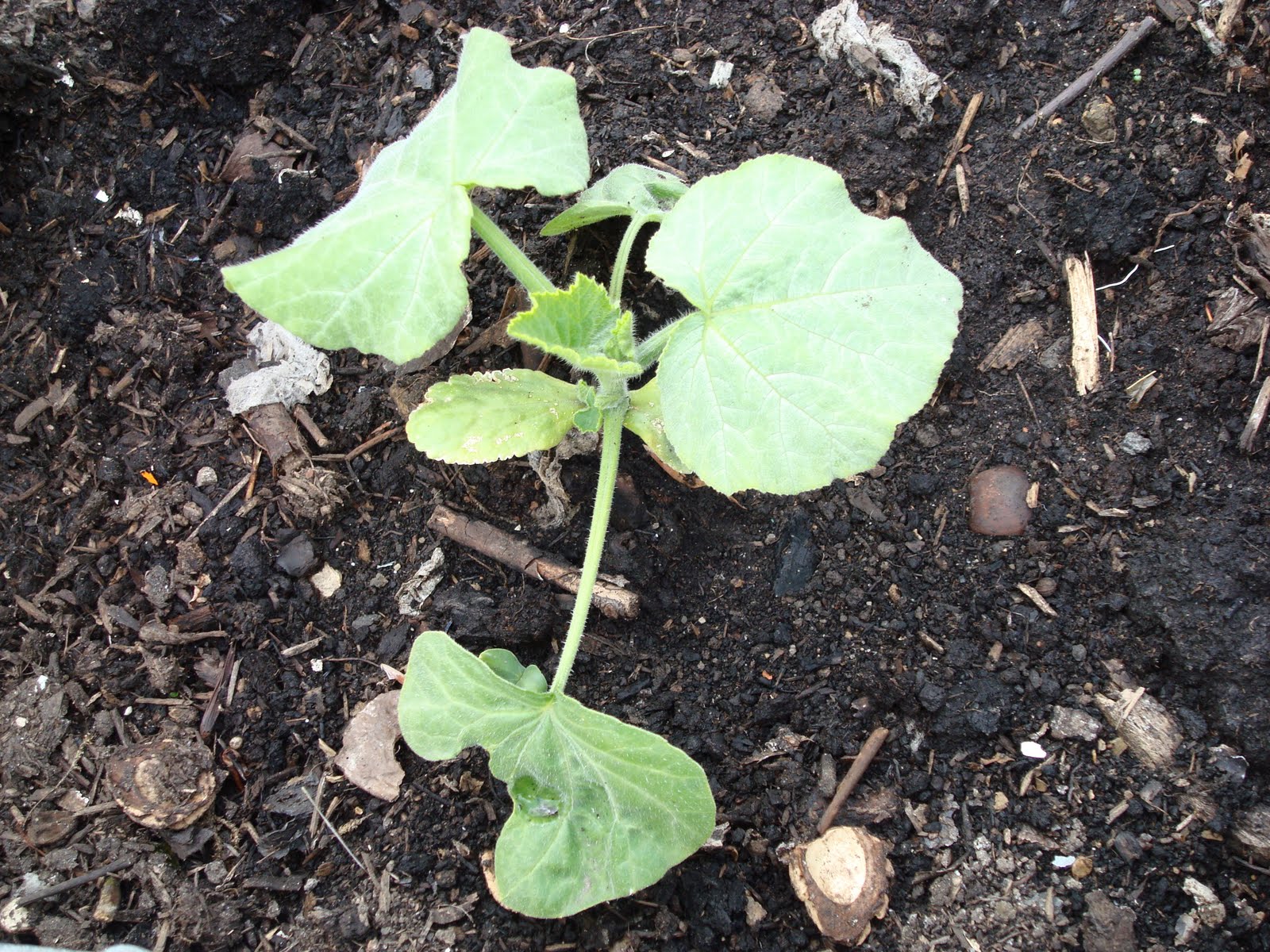
Earlier this year I bought a butternut squash, and saved the seeds from the centre.  I dried them on the windowsill, then sowed them about an inch deep in some organic compost.

About two weeks later I had seedlings, and a couple of weeks ago I transplanted them into one of the vegetable beds.  Two of them I have planted directly into the bed, but the remaining three I have potted up into old teracotta pottery "things". 


The reason for this is to try to save them from slugs for a little while, until they have time to build up some strength, and also to add a little variety to the garden.  Whether it's a good idea only time will tell.

Already there are signs of flower buds beginning to form, so, fingers crossed, I will have my free butternut squashes later in the year:-)

Monday, 31 May 2010

The herb border is establishing nicely

At the edge of what will, sometime relatively soon, be the patio, David has built a double retaining wall, which we have filled with a mixture of sieved soil and compost to create a herb garden.  Here you can see the onion sets just starting to come through.


This seems a much more attractive idea than putting a fence up to stop anyone falling off the patio down into the garden!  It's also highly practical, as I can then access my herbs without going down into the main garden, which, at the moment still retains the vestiges of the original lawn.  No more wet feet after collecting herbs when it's been raining!

I've transplanted coriander, chives, thyme and marjoram from the pots they were growing in into the bed.  Also rocket and nasturtiums from where they had self-seeded in the vegetable beds.  Bordering the steps down into the garden David created square planting areas, for larger herbs.

I have transplanted the purple sage and rosemary into the two squares by the steps nearest to the patio doors. 


Bay went into one of those over by the greenhouse.  I was going to transplant my lavender into the other one, but it's too leggy, so I'll take some cuttings and with any luck I can put some in next year.  Until then a Skimmia is looking after the site - keeping it warm, so to speak.

I'm delighted with how well the herbs have settled down, I took the opportunity to split the plants up whilst I was disturbing them, and in a year or two the border will be full.  I've sown some mixed salad seeds in to fill it up for now, no point in wasting the space, is there?

potatoes for free!

Last summer I grew potatoes from nothing, so to speak.  This year I've done the same.

I'm sure you must all have come across potatoes in your vegetable rack that look like this?  Yes?  So you snap off the growths and get on with preparing them for eating, yes?  No!  Not if you want free potatoes, you don't.

Cut off the growths with about an inch of the potato, and plant it in the garden.  Sometimes you can cut a potato in about half a dozen pieces, each with a shoot on, and plant each of them.  Each piece will grow into a potato plant, yes, really, each one a new plant.  Each plant will produce a crop of potatoes.

Admittedly, the crop will not be as large as from a seed potato, but then it's cost you nothing but a little time and effort.  The magic of nature works for you - aren't you lucky?

That's what I did about 3 weeks ago, and look at the growth they've put on!!  To obtain a larger yield of potatoes, simply pile earth up against the stems of each plant.  The obliging potato will generate new roots into this fresh soil, and they will produce the tubors for you.  Even better magic, and more free food :-)

Monday, 24 May 2010

A (Mostly) Vegetable-Free Edible Garden by Gem – ooffoo.com

I thought you might be interested to read that I'm not the only one out there who regularly eats flowers in her salads - Gem's mum eats more than I do:-)

I, too, have Jerusalem artichokes, lovely and nutty flavour.  They grow five or six feet tall, so only plant at the back of borders, unless you actually want them to provide shade!  Mine are behind the potatoes, but Gem's mum is really not into vegetables, so I won't talk about them.

I regularly eat nasturtium flowers and leaves, chives flowers and leaves, fennel leaves and seeds, rocket leaves, flowers and seed pods, beautiful purple spinach, grown for beauty as well as flavour, bay, thyme, marjoram, rosemary, lavender flowers, marigolds flowers, land cress leaves and so on ...

A (Mostly) Vegetable-Free Edible Garden by Gem – ooffoo.com

Wednesday, 12 May 2010

patio progression!

David is progressing well with the creation of the patio area - we're hoping to get it finished this summe - I'm so looking forward to holding a bbq!!!


Top photo shows existing herbs which have been establishing themselves nicely in one of the vegetable bed pending the creation of the herb bed. 


Middle photo shows the nearly completed herb bed, which will run the length of the patio - no more wet, yucky shoes when going out to harvest a few handfuls of herbs after a British shower - hooray:-)

As you can see, I've planted up one or two smaller specimens, but the larger ones need a fork taking to them, and my back's not been up to it today:(  But I have sprinkled a few seeds in there, including some salad leaves, even though they're not herbs - it's my bed, I can be creative:-)

This photo proves how hardy chard is - some of these plants are three years old now, and still flourishing with no molly-coddling through the winter, and they've been transplanted to the lower bed, and have survived this treatment, too :-)

Strange phrase, molly-coddling, isn't it?  Anyone know where it originated?

Sunday, 14 February 2010

Valentine's Day look at the garden

Happy Valenitne's Day :-)

We tend to ignore the day itself, as it is over-commercialised to such an extent. Hence David is busy removing the manhole cover which broke my wrist a couple of weeks ago, to send it for re-training reduce its height so that when we lay the gravel on the patio it won't be jutting up too much.


He thoughtfully arranged with nature's gardener to have a couple of snowdrops show their shy heads for me, in lieu of a bunch of flowers.  So  much nicer!

The blossom will soon be out on the Skimmia, too.  Lovely white flowers, currently protected by reddish-pink sepals in sweet little bunches.


The forsythia won't be too far behind - the buds are swelling, and soon those brown twigs will be covered in glorious sunny blooms.  So pretty because the leaves follow the flowers, so don't obscure them.


Enjoy your Valetine's Day, whatever you do :-)

Sunday, 7 February 2010

overnight frost, such beauty, vegetable garden


There was a hard, overnight frost a couple of days ago, so I took my little camera out into the back garden to investigate the beauty that ice brings.

As you can see, the sky was coolly attractive, with the sun disguised as the moon behind the banks of clouds.


My eye was taken with the stark beauty of the fennel seed heads, rimed with glittery frost.  Spiky yet rounded.  Dead, yet they had provided life for next season.  Please excuse my gloved digits at the left - it was tricky to isolate one head!


The glowing vibrancy of the rainbow chard was simply stunning.  Although leaves which are caught by the frost become inedible, it will send out fresh leaves for me to harvest on milder days throughout the winter.  I hope you didn't pull all yours up!


The tough leaves of the bay tree can withstand most things.  The arid days of summer, and the frosty times of winter leave it pretty much unharmed.

It's a slow-growing shrub, but well worth having in the garden to add a leaf or two to casseroles and curries.

The thyme looks so delicate and dainty with its white frosting.  Another herb which survives drought and frost in equal measure, and proves invaluable in everyday cooking.

The rosemary is the other herb which looks extra attractive when rimed with frost.  Each of those firm, narrow leaves sparkles individually in the early light.  Again, it withstands the dry summers and cold winters without complaining.

 The red onions I sowed last year are looking a little sorry for themselves, but I hope they will recover and continue to grow.  Time will tell, but my fingers are crossed.

It's good to get out in the garden to keep abreast of what's happening whilst I'm warm inside the house.

I hate to tempt fate, but I think I'm getting the hang of the new method of importing photos.  Who say's you can't teach an old dog new tricks????  Oh, I forgot, I taught myself!

Keep snug and away from bugs!

Monday, 23 November 2009

Rainbow Chard, Jewelled Stir Fry, Quick vegan supper

As I stood at the kitchen window, the late afternoon sun slanted through the leaves, creating jewel-like glowing clumps. I had made no plans for my evening meal, so I went out into the back garden to see what I could garner for supper.

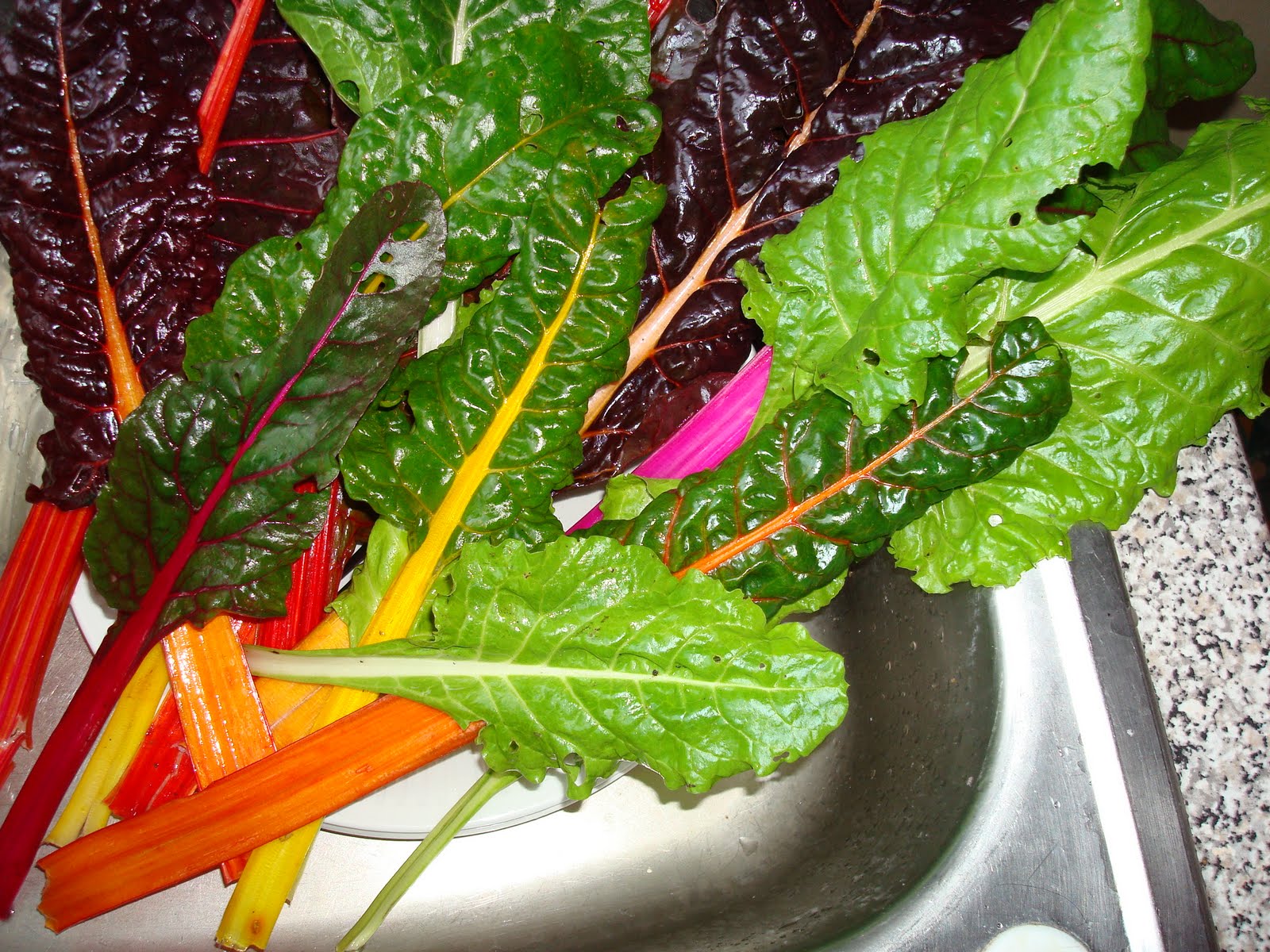
I harvested four different colours of chard, plus a standard white-stemmed variety. They don't look as good here in the sink as they did with the sunlight passing through them, but they're still quite stunning.


I decided on a simple stir fry, so took some celery from the fridge, a couple of onions from the basket, and started washing and chopping. Here's what I used, and how I made it:

4 sticks celery, sliced
2 large onions, cut in half, then sliced
8 sticks of chard
3 cloves of garlic, more or less, to taste!
2 chillies, finely chopped (remove the seeds and inner white ribs if you like it less hot!)
sesame oil
olive oil
soy sauce

Cut the ribs from the chard. Chop the ribs in the same way as you would the celery. Roll the leaves of the chard, and slice about a quarter inch or so thick ribbons. Don't they look like a dragon's lair of jewels?
I had red stems, bright cerise, orange and dandelion yellow stems, and the plain white ones, too.


In a large pan pour a glug each of olive and sesame oils. Gently fry the onion and celery until almost cooked through, then add the chilli and garlic.
Toss in the stems of chard, stir for a minute or two, then add the shredded leaves. I'm afraid the steam prevented me from taking a good shot of the leaves wilting down - sorry!

Splosh in some soy sauce, stir everything quickly together for about two minutes, and you're finished.

I served it with jacket potatoes, because my partner was here, and he loves them (so do I, but I would probably have had some rice noodles if I'd been alone).

A drizzle of toasted sesame oil over the top just finished it off nicely. The colours still looked lovely, even when cooked, and it tasted just great. What's more, it didn't take long to cook, and most of it came from the garden and cost very little - yay!!

Thursday, 22 October 2009

runner beans, free food, seeds, harvesting

Well, it's that time of year when things start to slow down in the garden. Although the days may still become warm and sultry, it's decidedly cooler in the evenings, and the plants are beginning to shut themselves down for the winter. Some will die down completely, others will slumber gently until the gentle warmth of Spring calls them forth again.


My runner beans are still flowering their little socks off, or would if they possessed any! At the same time, they are creating the seeds for me to harvest, and dry out, ready for planting again in the Spring. Free food :)

I always leave one plant, at least, to grow long, plump beans, which I don't harvest to eat. I allow them to stay on the plant until they have dried out. They don't look particularly attractive when they've turned papery in texture, and brownish in colour, but they contain that precious cargo of next year's seeds. For that alone, they could be considered beautiful. They have served their purpose, and that's a wonderful thing.

The photos show the pods agains the sunlight. If you look closely, you can see the shape of the beans within the drying pod, as the light can pass through the thinning shell of the pod, leaving the shadowy outline of the beans. Harvest when brown and dry.


The last shows the dried out shell, and some of the hidden treasure from within, revealed just for you! And aren't the beans pretty? Such attractive markings, and glorious colours. Bright pinks are fashionable just now - I wonder what a dress would look like created from fabric patterned like the beans. Probably quite attractive, I'd say. But then, I'm biased.

I store my harvested beans in an envelope, on which I write the variety and the date - I used to think I'd remember, but nowadays I know I won't, so I write it down. If I have plenty, I share them with family and friends who also appreciate organic, fresh food.

Monday, 14 September 2009

red, colour in the garden, vegetables, chard


Isn't red a beautiful colour? It warms the heart, and gladdens the soul. Today I'm going to share just a little of the glory of my garden at the moment.


The chard is positively glowing in the vegetable beds. Plumes of flame sprouting from the earth like mini volcanoes. The central stems can be cut from the leaf, and make a crisp vegetable, akin to celery. The crinkly, puckered leaves are soft, and similar to spinach, but with a stronger flavour. But the colour, the colour!!!


The reverse of the stems is that beautiful pinky red of the forced rhubarb stems that abound in early spring, so different from that of the inner rib that's visible.


The orangey red flowers of the runner beans are still framing the garden as they clamber over the arches. It's possible to see the long, broad runner beans (which are being left to provide seeds to sow next spring) dangling down from a couple of the plants. Once the decision has been made as to which plants to gather seed from, this plant will cease to produce new beans, believing it's job to be done. So only select one or two plants, or you'll lose production!

The Photinia Red Robin is confused, and sending up the deep, almost mahogany, new leaves it should be saving for next spring. I'm not complaing, though, as they are so beautiful, this photo doesn't really do it justice, but you get the idea.


The red Rowan berries are like clusters of small, round rubies. Allegedly this augures a harsh winter, so don't say you haven't been warned.


The autumnal tints are spreading on the Rose of Sharon leaves, and the berries are reddening on their way to being jet black.


The flat, multi-blossomed heads of the late summer flowering Sedum are just opening from within the palest green sepals. The contrast is spectacular - fresh green and rich reddy pink tones.
There's a lot to gladden the eye in the garden just now... I hope you've enjoyed seeing a glimpse.